On September 1st, James Dyson stood on a stage in Paris and unveiled a toothbrush with a camera in it. The CameraJet uses a 100,000 pixel macro lens and a machine learning model trained on 470,000 dental images to find the gaps between your teeth, then fires a jet of mouthrinse into them while you brush. Six years of development. 661 engineers. 38 patents. $499.99.
The coverage has been about the camera, which is understandable. It is a genuinely strange and impressive object.
But the most consequential thing they published last week was not the camera. It was a paragraph in the press release, and it deserves more attention than it is getting.
Why Dyson is talking about heart disease and dementia
Partway into the announcement, they cite the World Health Organization: nearly 3.7 billion people are estimated to be affected by oral diseases globally. Then this. Poor oral health, they say, is increasingly recognized as being linked to wider health conditions, including heart disease and Alzheimer's disease.
In the notes to editors, they list their sources. Harvard Health on gum disease and the connection to heart disease. The American Heart Association's scientific statement on periodontal disease and atherosclerotic vascular disease. The National Institute on Aging on a large study linking gum disease and dementia. Columbia University College of Dental Medicine on oral health and dementia.
That is a major consumer appliance company, with a global PR budget, telling the world that what happens in your mouth is associated with what happens in the rest of your body.
We at Oralucent have been saying this for years. It is nice to have the company.
To be precise about what those studies do and do not show: they describe associations and risk factors. They do not establish that gum disease causes heart disease or dementia, and no toothbrush treats, cures, or prevents any of those conditions. But the association is real, it is well documented, and it is the reason gum health is worth taking seriously as a health issue rather than a cosmetic one.
Two different problems: debris and biology
Here is where it gets interesting, and where Oralucent draws the line and they do not. There are two distinct problems in the space between your gum and your tooth.
The first is debris. Plaque, food, biofilm. Physical material that needs to be physically removed. This is what brushing and flossing have always been for, and it is a mechanical problem with a mechanical solution.
It is also the part most of us are not keeping up with. A CDC analysis of National Health and Nutrition Examination Survey data, covering 8,356 adults aged 30 and over, found that about 32 percent floss every day and about 32 percent had not flossed at all in the previous week. The rest floss sometimes. Roughly a third each way.
This is the problem they set out to solve, and they solved it with real engineering. A camera, a water jet, a new brush head shape, machine learning, a companion app, and a branded toothpaste and mouthrinse formulated to work with the system.
Whatever you think of the price, that is a great deal of invention aimed at a problem that a good sonic toothbrush, floss and a water flosser already handle reasonably well. It also arrives as a closed system, where the parts are designed to be bought together and continually re-bought as supplies diminish.
The second problem is biology. The tissue itself. Inflammation in the gum. The bacterial populations that live below the gumline and drive that inflammation. The healing response of gingival tissue that has already been damaged.
Nothing in that machine touches this layer. It is not a criticism. It is a description. They built a debris removal system, and they do not claim otherwise.
But debris is the input. Inflammation is the output. And if the tissue is already inflamed, or the bacterial balance has already shifted, removing more plaque more efficiently is necessary and often not sufficient.
How light works on gum tissue and bacteria
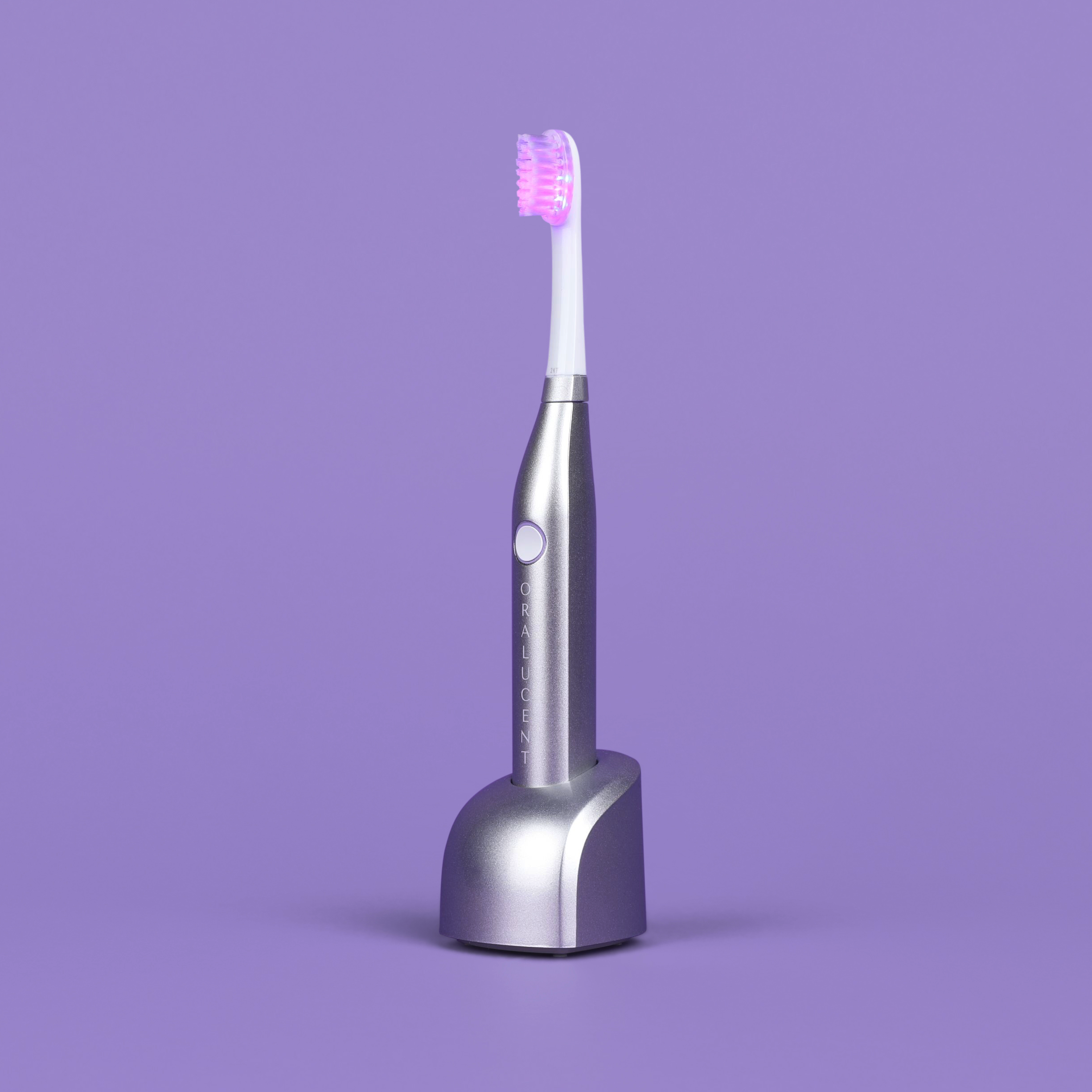
Biology is the problem the Oralucent Pro Edition was built to address, and it is why our brush has LEDs in the head instead of a camera. The Pro Edition is a 40,000 stroke per minute sonic toothbrush, proven technology for clearing debris and plaque. The innovation and differentiator is the Pro Edition's two wavelengths of light.
660nm red light

Red light in this range has been studied for photobiomodulation, a process in which light energy is absorbed by cells and appears to support tissue repair and reduce inflammatory signaling. In dental research, red light exposure has been linked to improved gingival tissue response and reduced inflammation. A 2024 study in the Journal of Dental Research looked at how human gingival cells behave when they are exposed to live oral microbes and then treated with light, and found the light shifted those cells away from a purely inflammatory response. That work was done in a laboratory cell model, at different wavelengths than our device uses, so it speaks to how the mechanism works rather than to the product itself.
Blue light at 430nm
Blue light works on a different principle, and the biology behind it is worth understanding, because it explains why the effect is targeted.
The bacteria most associated with periodontal disease, including Porphyromonas gingivalis, cannot manufacture their own heme. They have to take it from you. These organisms break down hemoglobin in the gum crevice and concentrate iron protoporphyrin on their outer surface, which is why they appear black when grown in culture. The pigment is not something the bacterium builds. It is host material, scavenged and accumulated.
That borrowed pigment absorbs blue light strongly, and at 430nm the absorbed energy sets off a reaction that produces reactive oxygen species and damages the bacterial cell. What makes this useful is where the pigment comes from. The more inflamed and bleeding a site is, the more heme is available there, so the bacteria living in it carry more pigment and absorb more light. The effect concentrates itself in exactly the places that need it. Researchers call this antimicrobial photodynamic therapy, and it has been in the peer reviewed literature since at least 2005.
A 2015 study in Lasers in Medical Science applied blue light to one side of the mouth, twice a day for four days, and left the other side untreated as a control. Porphyromonas gingivalis on the treated side fell by about a quarter and Prevotella intermedia by more than half, while the untreated side showed no change. That study involved eleven people and used a slightly different wavelength than our device, but it demonstrates the mechanism working in a mouth rather than in a petri dish.
We have run our own human trial as well. Nine participants brushed normally with the Pro Edition, and the five bacterial species most associated with periodontal disease, the group clinicians call the high-risk five, fell by an average of 81 percent from baseline. The result was statistically significant (p<0.01). While this is a small number of participants and it is unpublished, it points in the same direction as the published research.
So which one should you buy?

Most people who find Oralucent are already concerned about their gums. Some have bleeding after brushing or flossing that they have stopped ignoring. Inflammation that will not settle. A hygienist mentioning pocketing at the last cleaning, and the sense that brushing harder is not going to be the answer. Others arrive from a different direction, thinking about the oral systemic connection, or about what it takes to still be healthy at eighty. Either way they searched red light therapy for gums, or electric toothbrush for braces, or receding gums, or whether gum tissue can recover once it has pulled back, and ended up here.
If that is you, what you are really asking about is gum health: fewer cavities, inflammation that finally settles, fewer of the bacteria driving it, and tissue that holds. Your gums are part of your body's first line of defense, just like your skin. None of this replaces the basics, so keep brushing with a sonic toothbrush, keep flossing, use a water pick, and keep your cleanings. But underneath all of it is one question: what is happening to the gums themselves. That is where Oralucent really shines.
Our reviews are full of people describing good news at their next cleaning. They tend to mention how their mouth feels first, but the confirmation comes from the hygienist, while they are still in the chair.
Gum pocket decreased from 6 to 5 since last cleaning 4 months ago.
Just went to my dentist appointment and all of my pockets have decreased in depth. I am so happy that I found this amazing toothbrush.
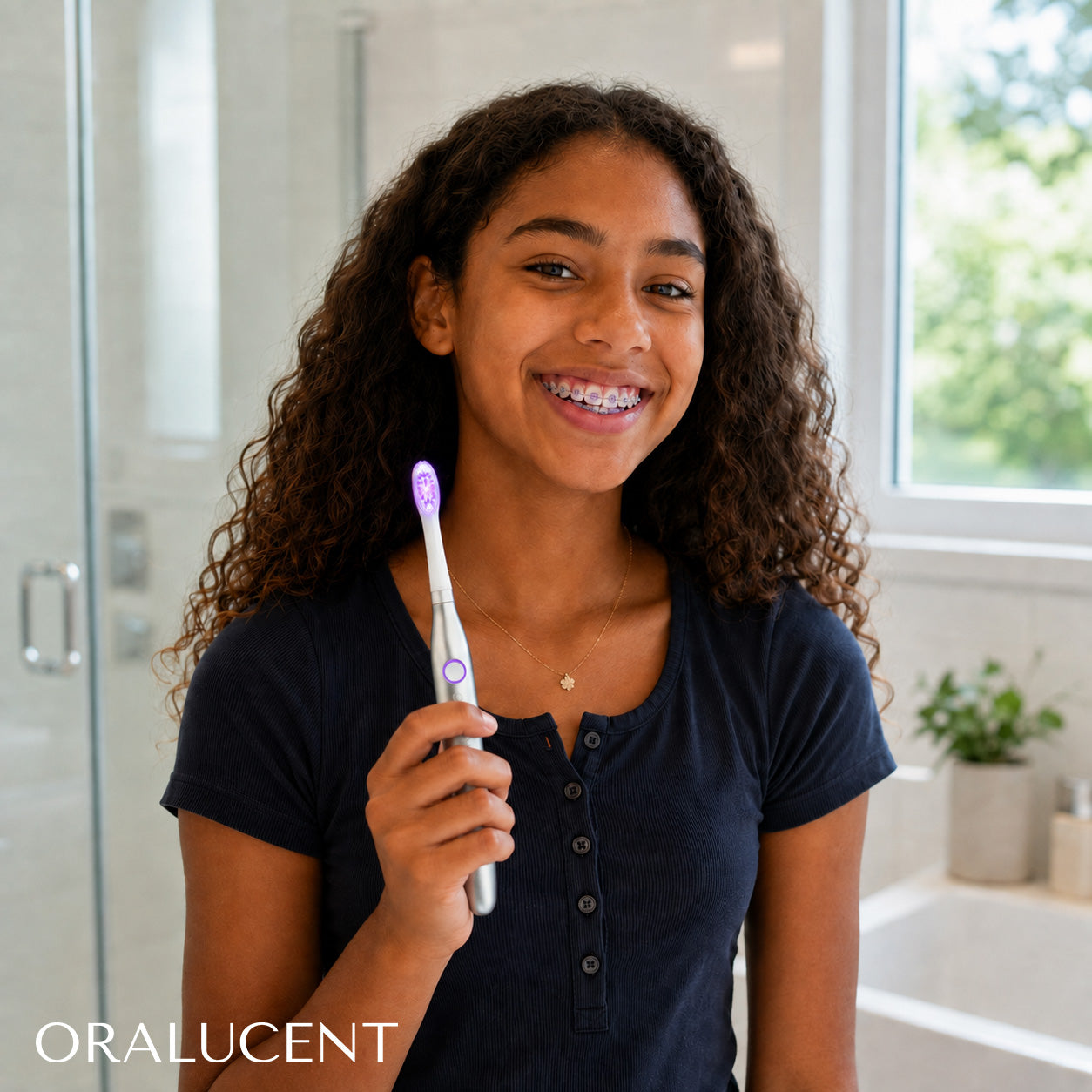
Oralucent was built for anyone twelve and older. If your gums are inflamed today, this is a place to start. If your gums and teeth are healthy, Oralucent and good oral care habits are how you support them. There is no threshold you have to cross first and no diagnosis you need to be handed before it is worth looking after your gums.

What people describe is quieter than a transformation, and better than one. Rinsing at the sink and seeing nothing but water. Sitting through a cleaning and hearing good news instead of a plan. Smiling in a photograph without thinking about it first. Gum health is silent when it is going well, and that silence is worth a great deal, both for how you feel every day and because of the association researchers keep finding between healthy gums and health everywhere else. Two minutes a day, in a routine you already have.
Healthier Smile. Healthier You.
The Oralucent Pro Edition is a dual-LED light therapy sonic toothbrush. 660nm red and 430nm blue light, 40,000 sonic strokes per minute, 4+ weeks of battery life on a charge. A 60 day money back Smile Guarantee, even if the package is opened!
60-Day Smile Guarantee. 1-Year Worry-Free Warranty.
- Ships Fast & Ships Free: Typically ships within 1 business day with free ground shipping on orders over $169. Expedited shipping is available.
- 60-Day Smile Guarantee: Try it risk-free. If you’re not completely satisfied, return it—no questions asked.
- 1-Year Worry Warranty: Enjoy peace of mind with our full one-year product warranty.

References
- Tanum J, Kim HE, Lee SM, Kim A, Korostoff J, Hwang G. Photobiomodulation of Gingival Cells Challenged with Viable Oral Microbes. Journal of Dental Research. 2024;103(7):745–754. DOI: 10.1177/00220345241246529. https://pmc.ncbi.nlm.nih.gov/articles/PMC11191660/
- Soukos NS, Som S, Abernethy AD, Ruggiero K, Dunham J, Lee C, Doukas AG, Goodson JM. Phototargeting oral black-pigmented bacteria. Antimicrobial Agents and Chemotherapy. 2005;49(4):1391–1396. DOI: 10.1128/AAC.49.4.1391-1396.2005. https://pubmed.ncbi.nlm.nih.gov/15793117/
- Soukos NS, Stultz J, Abernethy AD, Goodson JM. Phototargeting human periodontal pathogens in vivo. Lasers in Medical Science. 2015;30(3):943–952. DOI: 10.1007/s10103-013-1497-9. https://link.springer.com/article/10.1007/s10103-013-1497-9
- Yoshida A, Sasaki H, Toyama T, Araki M, Fujioka J, Tsukiyama K, Hamada N, Yoshino F. Antimicrobial effect of blue light using Porphyromonas gingivalis pigment. Scientific Reports. 2017;7:5225. DOI: 10.1038/s41598-017-05706-1. https://www.ncbi.nlm.nih.gov/pmc/articles/PMC5507902/
- Fleming EB, Nguyen D, Afful J, Carroll MD, Woods PD. Prevalence of daily flossing among adults by selected risk factors for periodontal disease: United States, 2011–2014. Journal of Periodontology. 2018;89(8):933–939. DOI: 10.1002/JPER.17-0572. https://pubmed.ncbi.nlm.nih.gov/29644699/
- Oralucent, data on file. Human trial, n=9, unpublished.
Oralucent does not diagnose, treat, cure, or prevent any disease. Statements regarding associations between oral health and systemic conditions describe documented risk associations and are not claims of treatment or prevention.